

With design practices now favoring the use of exterior continuous insulation, it’s important for architects and engineers to understand how the most common insulation solutions perform under different circumstances — specifically when exposed to liquid water, not just vapor, since the exterior layer is more prone to water exposure. Materials considered “open pore,” like mineral wool, are more susceptible to high water absorption than “closed pore” insulation like polyisocyanurate (polyiso).
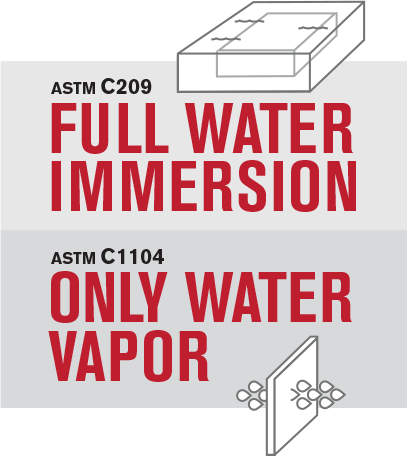
Mineral wool and polyiso, while used for the same purpose in the building envelope, have been subjected to different testing methods, meaning there is no accurate comparison of their performance characteristics in regard to absorption, rewetting and drying. Mineral wool has typically been tested in accordance with ASTM C1104, which utilizes water vapor (95 ±3% RH). Polyiso, on the other hand, is tested in accordance with ASTM C209, which submerges the product under one inch of standing water for two hours.
To provide a better comparison of the absorption and drying characteristics of polyiso and mineral wool, a recent study subjected specimens of mineral wool and polyiso products — coated-glass faced and foil faced — to ASTM C209 testing protocol. Both the mineral wool and polyiso samples were immersed in liquid water for the initial wetting test, allowed to dry, and then measured.
Subjecting mineral wool to the same rigorous sorption testing as polyiso proved liquid water has significant effects on mineral wool’s structure and performance. When mineral wool was initially wet in accordance with ASTM C209, results showed:
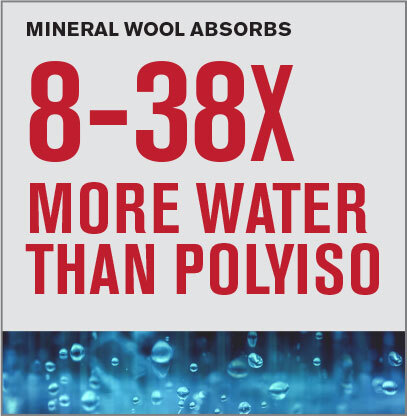
- Mineral wool absorbs 18% to 78% of its weight in water. In comparison to polyiso, mineral wool absorbs 8–38 times more water than foil faced polyiso and 4–19 times more water than glass faced polyiso.
- These findings prove water absorption is directly linked to pore structure. Open, fibrous mineral wool absorbs and retains significantly more water than rigid, closed-cell polyiso.
- Mineral wool is inconsistent.
- Tests were conducted on two different brands of mineral wool with similar product declarations, but significant differences in absorption rates were observed. Sorption values even varied significantly between individual pieces from the same product bundle.
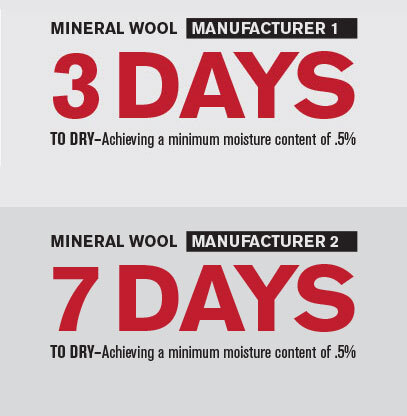
- Mineral wool takes between 2 to 6 days longer to dry than polyiso.
- Due to its open pore structure, water is suspended by capillary forces and the network of fibers. This negates common claims that mineral wool dries quickly due to its high vapor permeance.
Under the same test conditions, polyiso samples vastly outperformed mineral wool:
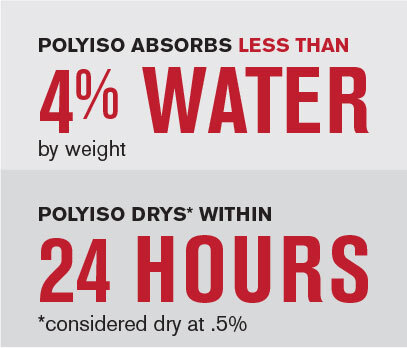
- Foil faced and glass faced polyiso absorbed less than 4% water by weight and 0.13% by volume, and both were effectively dry within 24 hours.
- This again validates that sorption potential is linked to pore structure, as polyiso has a rigid, solid framework.
Next, the effects of rewetting were examined to determine performance under repeated exposure to liquid water. Polyiso and mineral wool both underwent a first phase of rewetting, which found that polyiso showed no appreciable increase in rewetting and no significant changes in drying time.
Mineral wool samples reacted quite differently to rewetting, after rewetting through seven cycles and then tested in accordance with ASTM C209 (after the initial wetting and drying) these tests revealed:
- Water absorption increased by 132–195% and extended dry times by up to 4 days.
- Rewetting tests revealed dramatic increases in absorption, which is significant, as standard sorption test results don’t account for prior exposure to liquid water. This means even a single previous exposure can result in increased sorption.
- Repeated wetting of mineral wool revealed moisture holding capacities that vary due to changing pore and fiber structure.
- Past research suggested increased sorption is linked to separation of fibers from the binders that hold them together. However, this new scenario takes void geometries (the spaces between the mineral wool fibers) into account. These voids changed in size and shape, resulting from bulk water transport during wetting and draining.
- As mineral wool was rewet over the seven cycles, separation of fiber layers and physical voids became obvious, causing the product to absorb and drain differently. This implied physical product changes are the main cause of absorption upon rewetting.
Because polyiso and mineral wool have been evaluated using different methodologies, architects and engineers have a harder time comparing and evaluating potential risks when choosing insulation solutions. Based on the findings from this study, previous sorption potentials for mineral wool have been vastly underestimated, as even partial wetting negates the insulating performance of mineral wool.
Polyiso has been proven to have low absorption potential and high drying potential, and continued exposure to liquid water does not degrade the structure of the material, as it does mineral wool. It’s clear from this study and practical applications that polyiso is the best choice for continuous exterior insulation in any building envelope that requires continued high performance.
For more information on how polyiso performs when subjected to water, please contact a rep here.